
I Can’t Predict the Future (And Neither Can You)
Teresa Torres is one of the most respected voices in the industry when it comes to product discovery—through her Continuous Discovery Habits book and Product Talk Academy courses, she’s taught thousands of product managers to talk to their customers more regularly and build out their discovery skillsets.
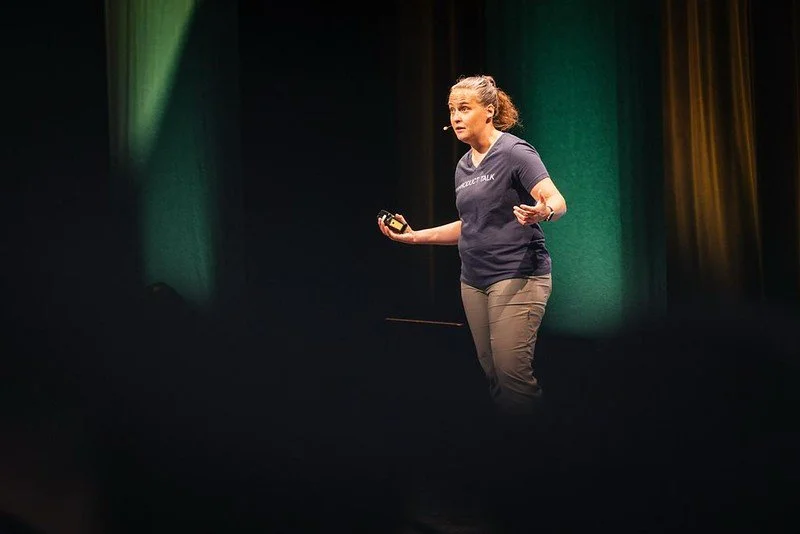
But in March 2025, a serious injury caused Teresa to step back from her day-to-day work as a product coach and explore the potential of AI. In Teresa’s keynote, she takes us along on her journey and invites us to consider the implications her story might have for our own learning and exploration.
Keep reading for the highlights, or check out the video of her keynote below.
A simple beginning: Lots of free time and the sense that change was coming
“Today my job looks radically different than it did a year ago,” said Teresa. “I’m going to tell you my story—not because I want you to do the same thing—but because I think it’s an amazing story of continuous improvement, of how teeny-tiny steps compound over time.”
Before she dove in, Teresa asked the audience to pay attention to three key questions:
Where are you today?
What are you willing to be a beginner about?
And how can you take a teeny-tiny first step?
Teresa’s journey all began in March 2025 when she broke her ankle and spent three weeks on the couch recovering from surgery. It was the first time in 15 years that Teresa was physically unable to think about her business. “It was the best thing that could have ever happened to me,” Teresa admitted.
At the time, Teresa was a total novice when it came to AI. She was using ChatGPT as Google—just asking it questions.
But Teresa could sense that there was something more.
Every time she opened LinkedIn, she’d find people she’d never heard of talking about AI and discovery.
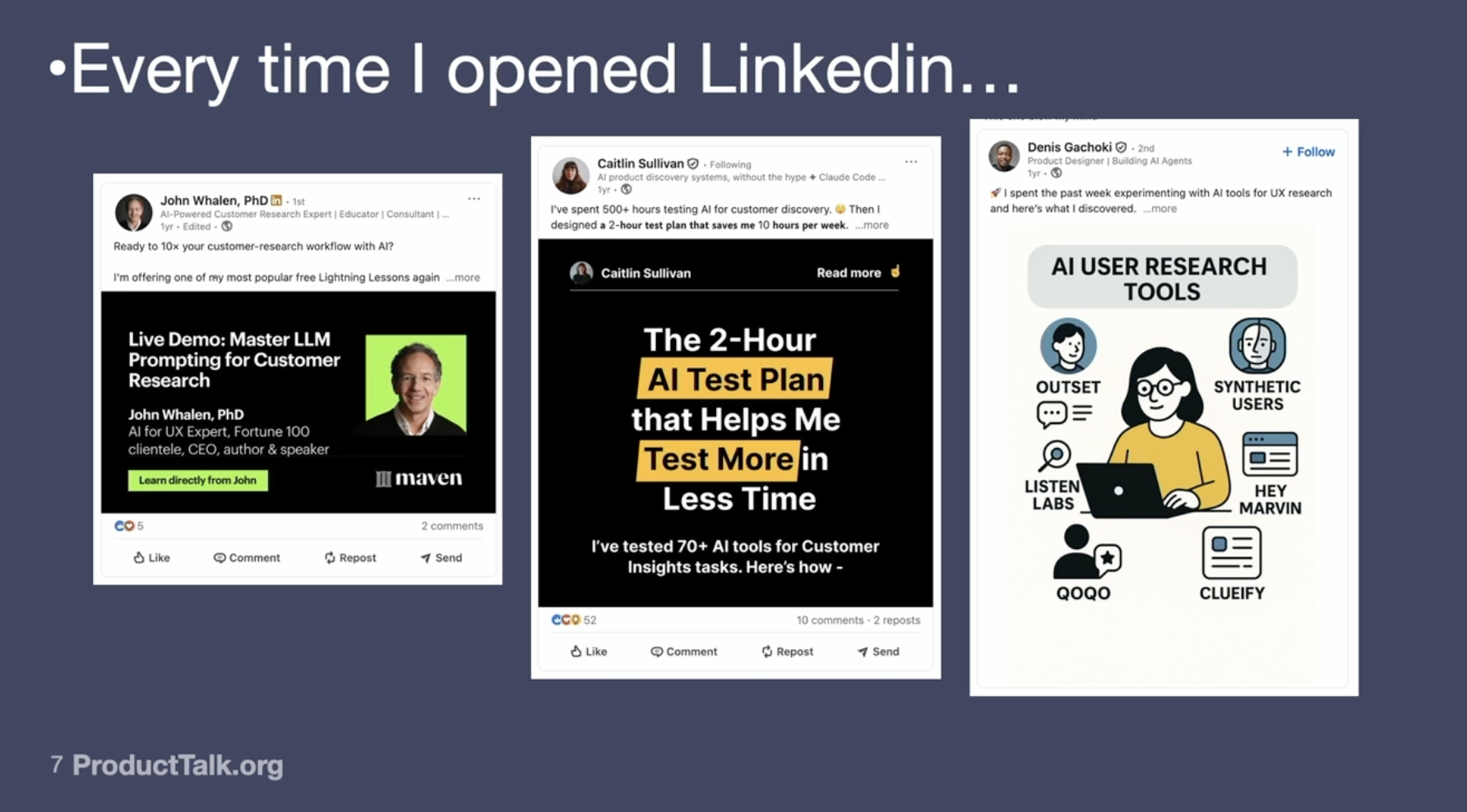
Teresa admits that at the time, she was very comfortable in her world. She was also cynical about AI’s ability to change discovery. “I had a million reasons why AI wouldn’t change discovery,” she said.
But every time she went to LinkedIn and saw all the trailblazers, she started feeling uneasy. “I was scared. I could see my life’s work being left behind,” said Teresa.
The first step: Turning fear into curiosity
Teresa believes that if we want to build good products, we have to get really good at product discovery. But she could also see that product discovery was changing, so she had to ask herself a scary question: Was she going to change with it?
“When I get scared, I tend to get curious,” explained Teresa.
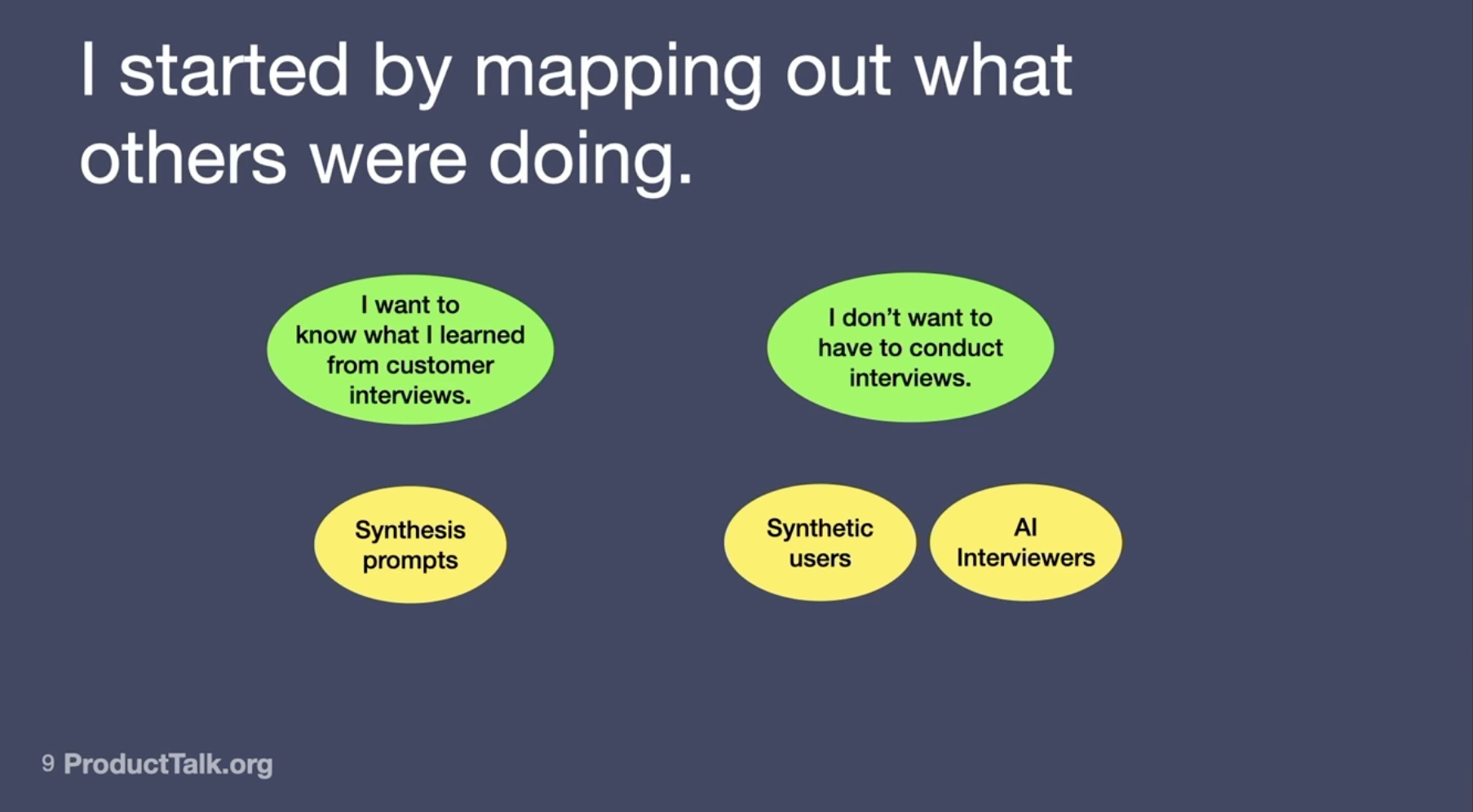
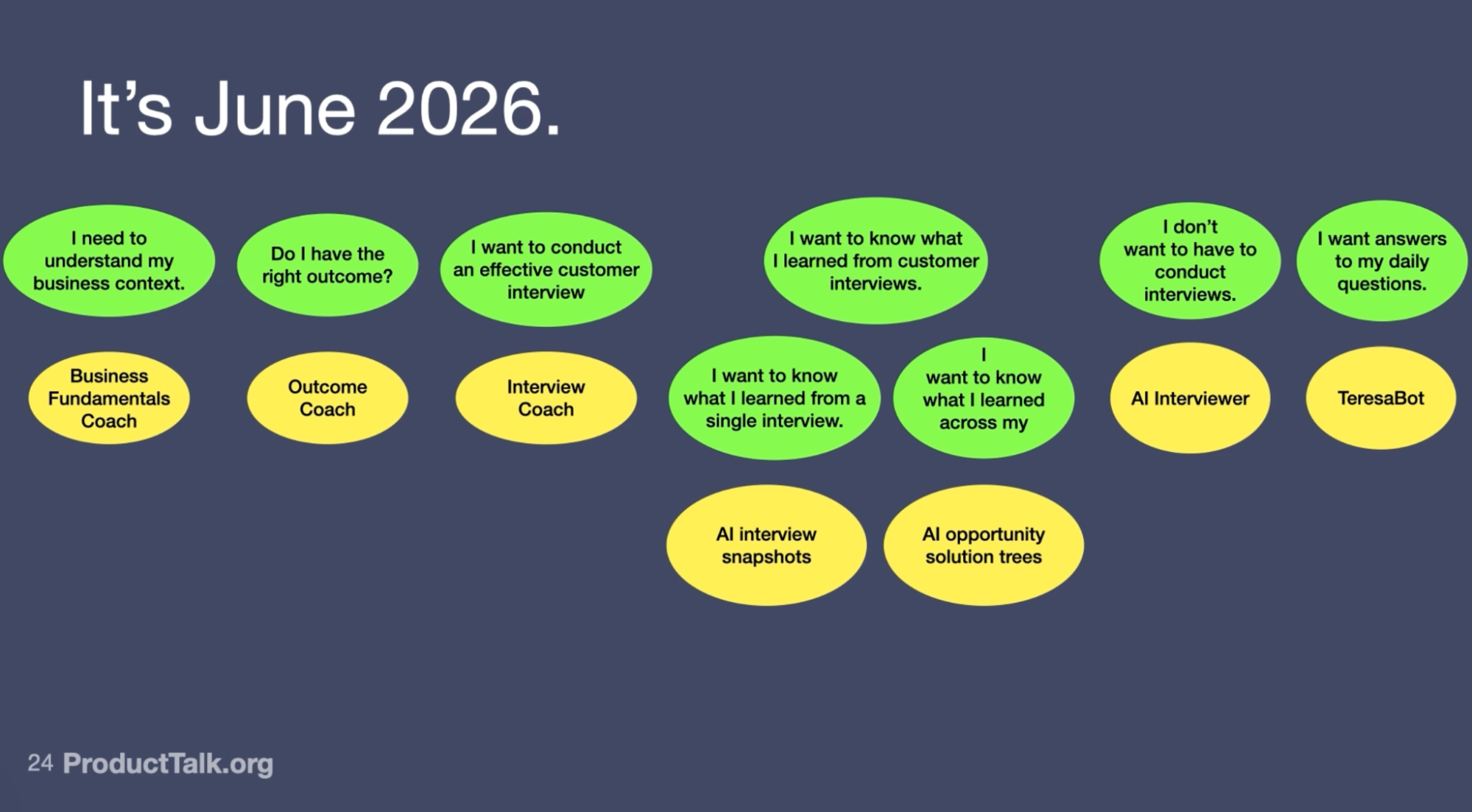
So Teresa began mapping out what others were doing. She could see that they fell into two camps: The people who wanted to get better at synthesizing what they were learning from customer interviews and the people who didn’t want to have to conduct customer interviews at all.
It was clear to Teresa that she only wanted to focus on the first camp—the people who are committed to conducting interviews and just want to get better at it.
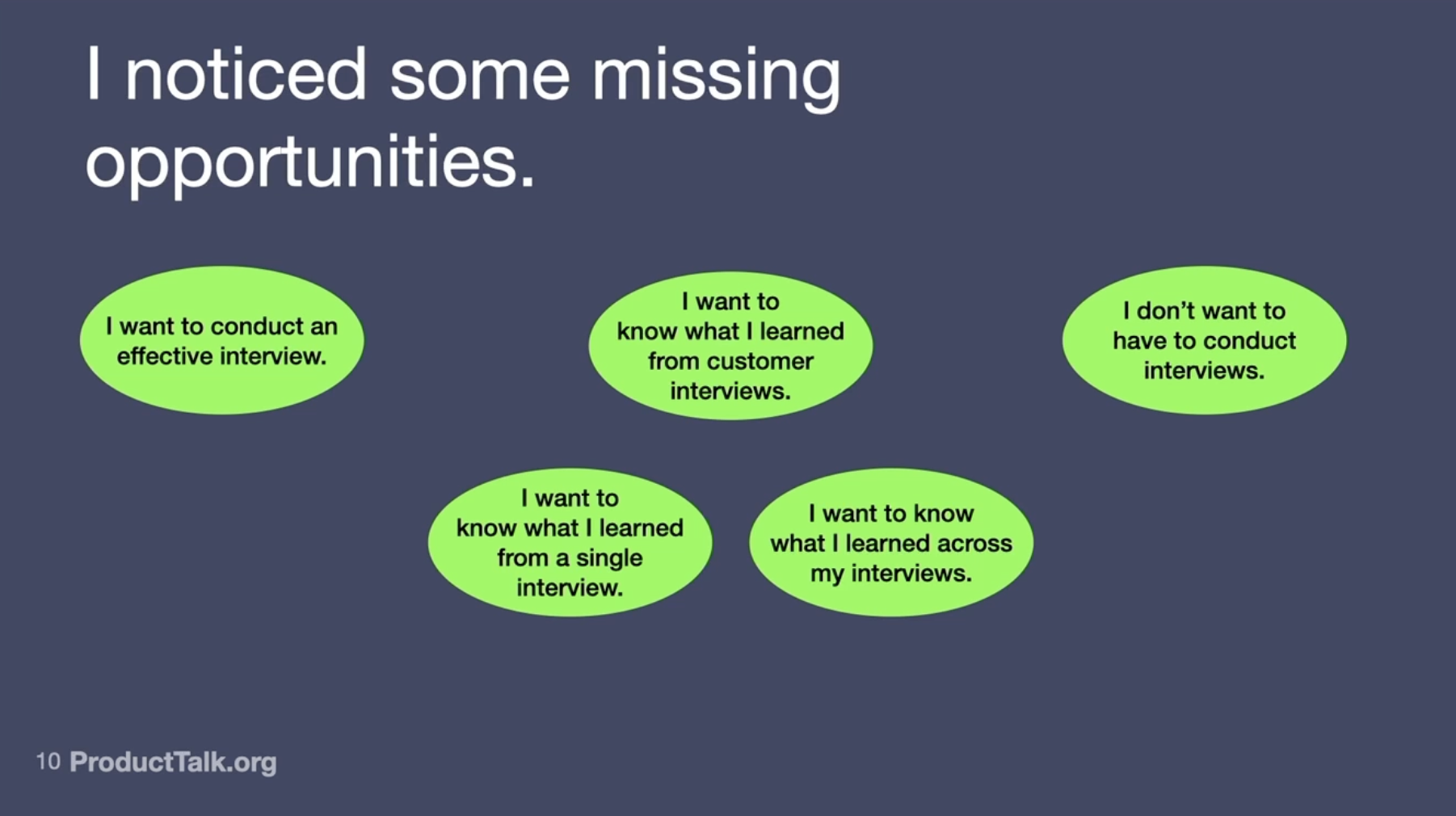
And as she reflected on her work as a discovery coach, Teresa realized that many product teams are getting better at talking to customers on a regular basis, but they’re not getting better at how they talk to customers.
So she went back to her opportunity map and added in some opportunities that were missing.
Early experiments: Can AI help people conduct more effective customer interviews?
At this point, Teresa had narrowed in on a promising opportunity: “I want to conduct an effective interview.”
But what exactly does it mean to conduct an effective interview? Teresa had already given this question a lot of thought. In her Continuous Interviewing course, instructors and students use a rubric Teresa developed to assess their skills at running a story-based interview.
Teresa started wondering if AI could give good feedback, so she took the rubric from her course and turned it into a prompt.
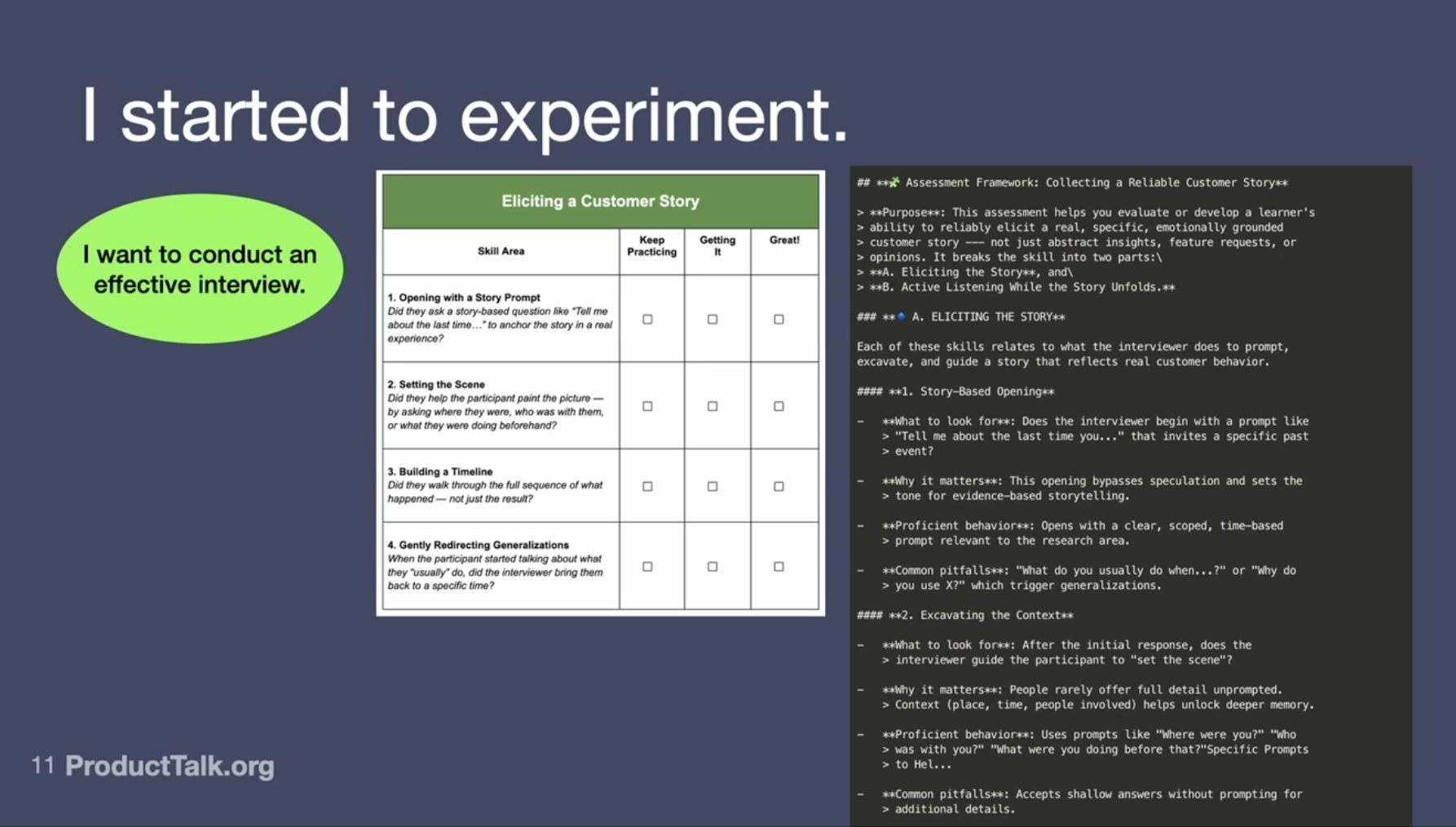
She quickly built the MVP of the Interview Coach, which would take a transcript from a customer interview, assess it against Teresa’s rubric, and deliver personalized feedback.
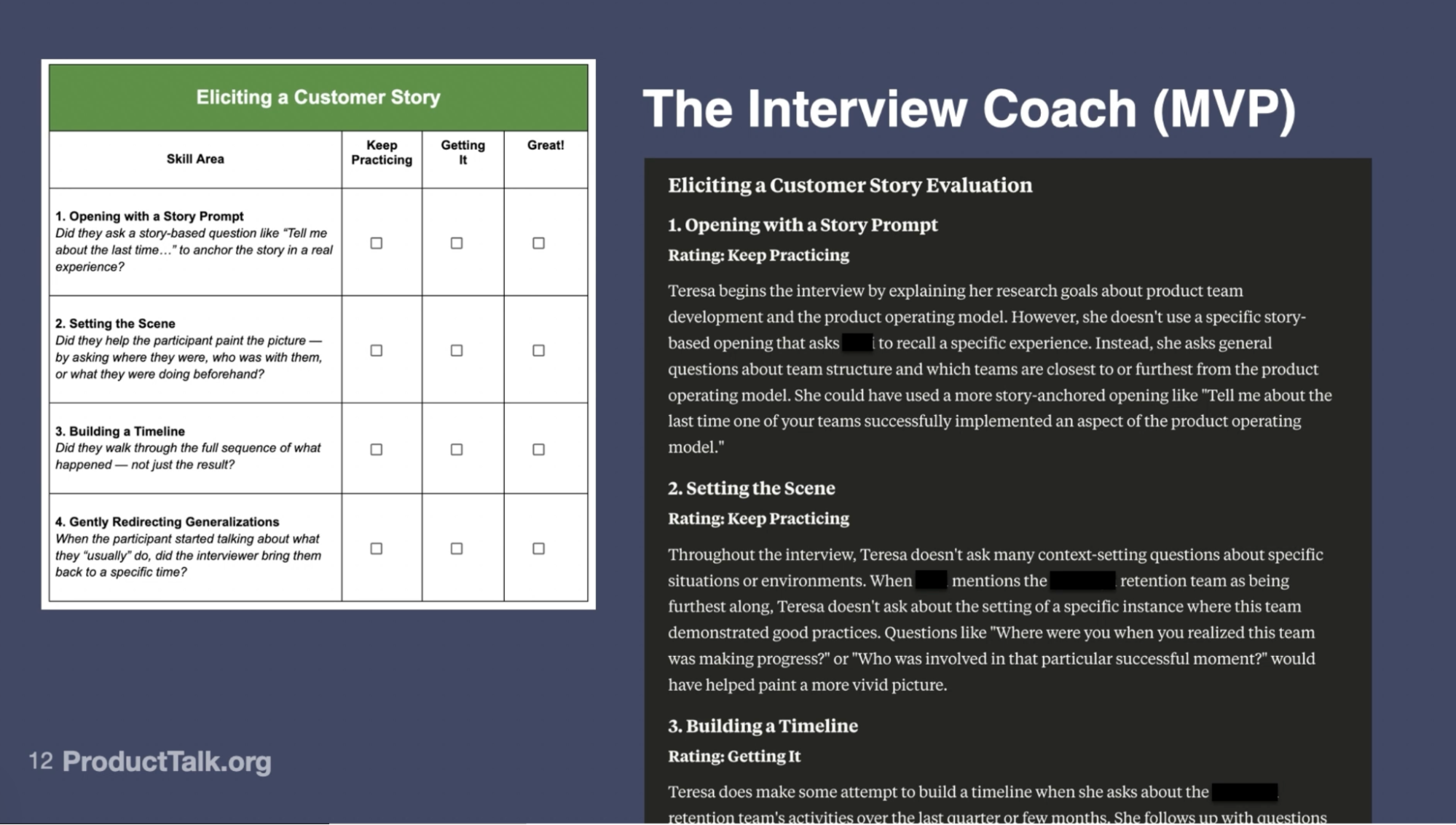
Teresa was surprised by how good AI was at this. And this experience opened her eyes. Teresa started asking, “If AI can do this, what else can it do?”
Rising to the challenge
Teresa was excited by the potential she now saw in AI. This was a radical change from her early days of using ChatGPT as Google. At this stage in her journey, a few things happened:
Teresa was invited by Vistaly to bring her AI products into their software. “One little experiment that happened to turn out well turned into an invitation to integrate it into a real product,” said Teresa.
In the quest to answer the question, “Is my AI coach any good?” Teresa encountered a course on AI evals, which are feedback loops that enable us to build good AI products.
Teresa learned about Claude Code and began using AI as her task management and admin tool. “I want to focus on my content and helping teams do discovery; I’ll let the agents do the things I don’t want to do,” Teresa explained.
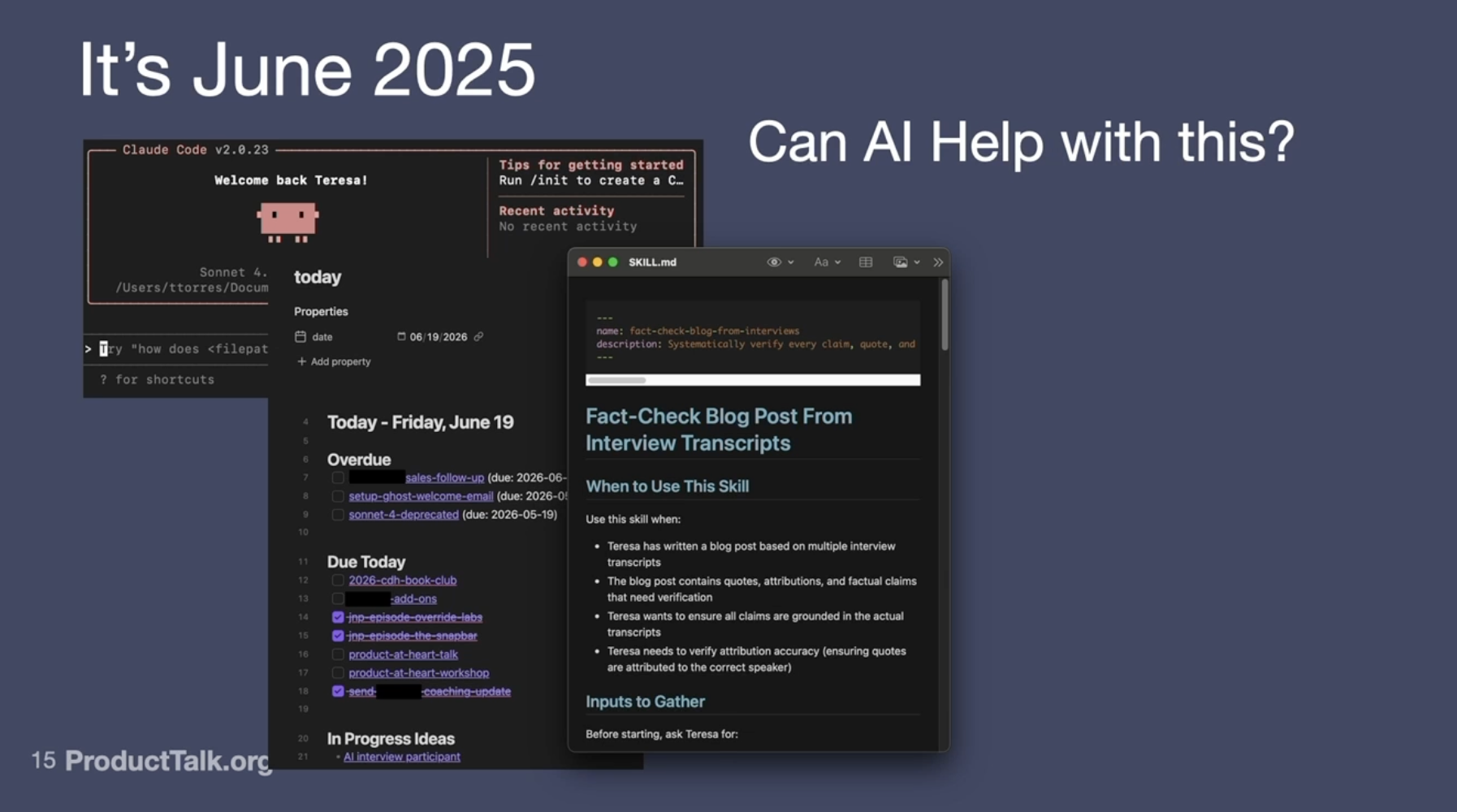
“Playing with personal productivity with tools like Claude Code taught me the skills I needed to become an AI creator/builder/engineer,” said Teresa. And this was a safe playground where she didn’t have to worry about having any impact on customers.
Seeking opportunities for learning and expansion
In the next phase of her journey, Teresa realized that she wanted to learn from others. She launched her podcast, Just Now Possible, where she interviews product teams about the AI products they’re building.
She was also intrigued by research published by Claude about AI interviewers. This got Teresa curious about whether she might be able to build a better AI interviewer.
Here’s a glimpse at what Teresa’s opportunity solution tree looked like at the time.
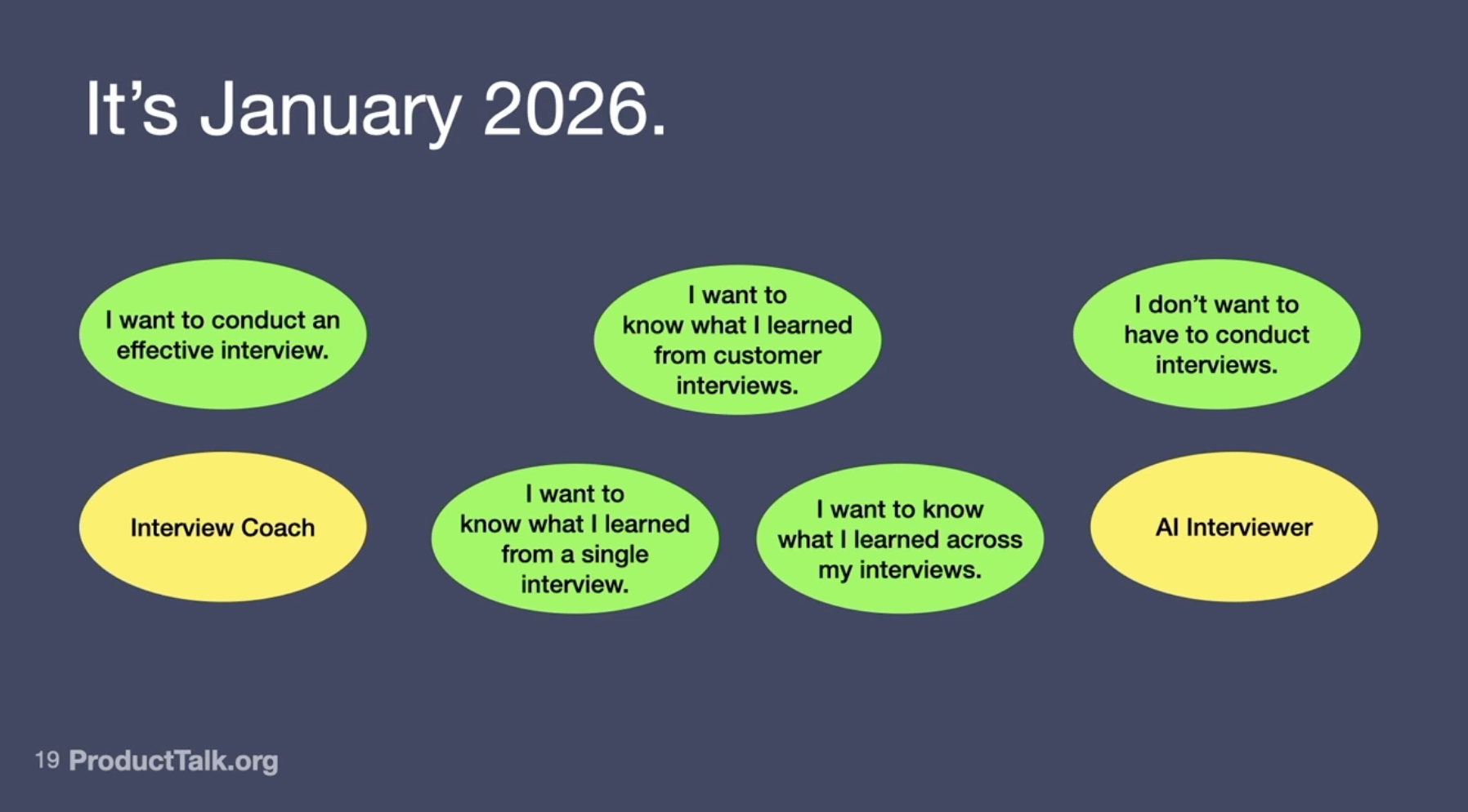
And she’s continued to build on this foundation. In the months since, Teresa has:
Announced a partnership with Vistaly where customers can generate an opportunity solution tree based on a customer interview transcript.
Built an Outcome Coach on her blog, where you can submit an outcome and get personalized feedback on whether it’s a business outcome, a product outcome, or an output.
Created a TeresaBot that can respond to questions and provide links to relevant resources from Teresa’s content archives.
Spent every waking hour for two weeks resolving an AI and code bug in the Vistaly opportunity solution tree product.
These are all things Teresa never imagined she’d be able to do. But now she’s realized that she can figure it out. “This is the message I want you to take away: You can figure it out. Whatever it is that you want to do, you now have access to an expert tutor 24/7,” said Teresa.
Putting it all into context: The Hero’s Journey
As Teresa reflected on this past year, she saw that her story followed a narrative that humans have been talking about for centuries: the hero’s journey.
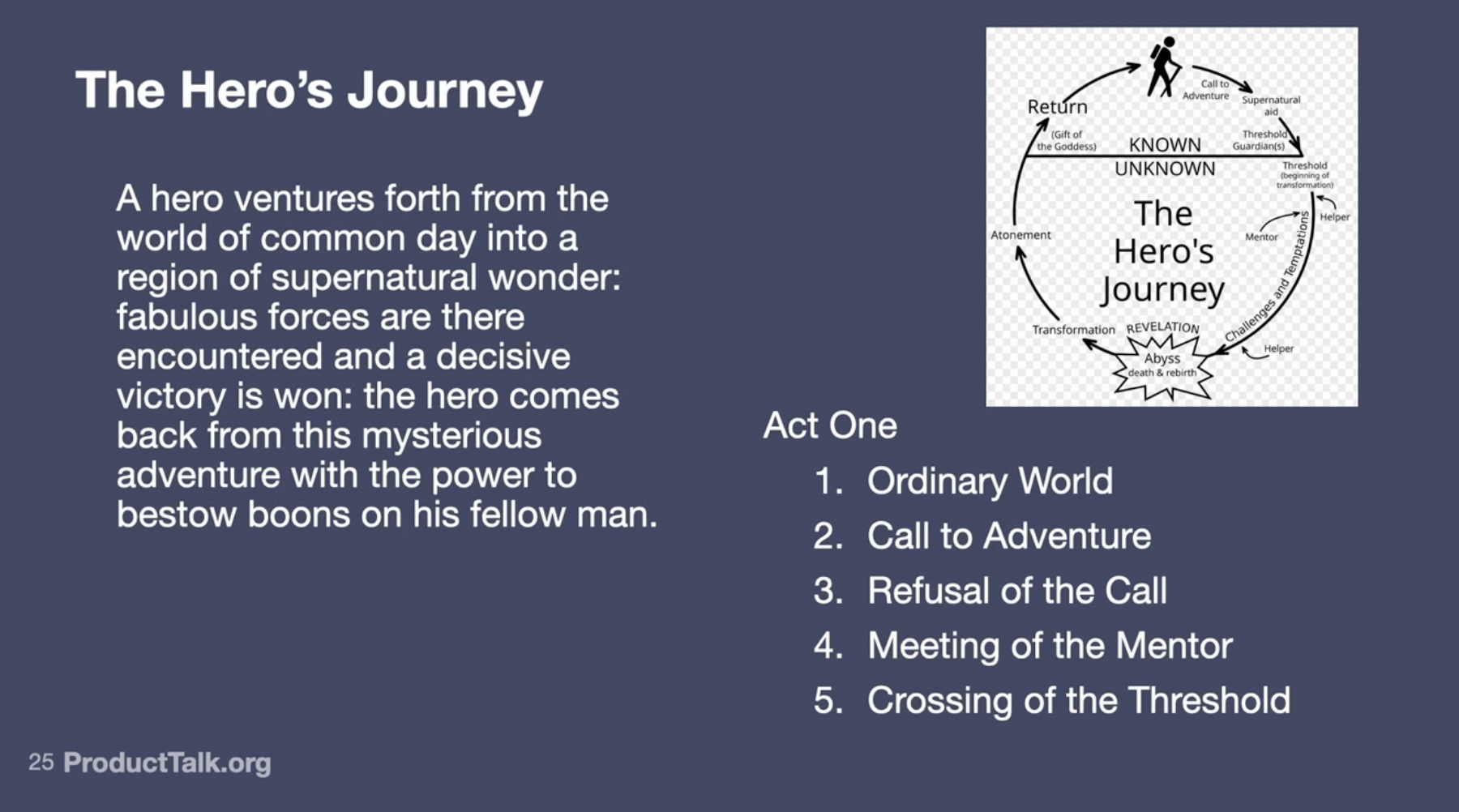
Teresa began in the comfort of her ordinary world and she heard the call to adventure, though at first she resisted it (her “million reasons why AI won’t change discovery” line of thinking). But eventually, she decided to take the first step, exploring what was possible. And luckily, she met some mentors in the form of her partners at Vistaly, the teachers of her AI evals course, and the product teams who nerd out with her on the Just Now Possible podcast. And her work is transformed—she’s gone from creating courses to teach discovery to building software to teach discovery.
To close out, Teresa reminded us what she believes we can take away from her story: “Every one of us is facing change. We are all being called to adventure. All I did was heed the call. I took the first step, which led to the next. None of them were that scary—except for the first one.”
As we each face our own adventures, Teresa invites us to wander joyously into the unknown, to take advantage of the moment, and to get comfortable with being beginners again. What does your first step look like?