Radically Rethinking Metrics
How do you feel when someone asks you to meet a specific goal or metric? If it gives you a sense of dread or anxiety, you’re not alone. But what if someone asks you to solve a puzzle instead? It evokes a different feeling that sparks your creativity and curiosity. And it just sounds like a lot more fun!

In her Product at Heart keynote, Radhika Dutt argued this point: Goal-setting is an outdated and unmotivating way of approaching our work, while puzzle-setting and solving make us more ambitious, aligned, and motivated.
We’ll share a few highlights from Radhika’s keynote below, or you can watch the full video here.
If you’ve ever watched a Star Wars movie, you’ve probably noticed a strange contradiction. The Stormtroopers (the soldiers in those white plastic uniforms) are constantly running around, firing everywhere. And yet they never seem to hit anything.
This might feel familiar to anyone who works in a corporate environment where “everything is a priority.” You’re constantly chasing goals and targets, but you may not feel like you’re actually having much of an impact. Radhika refers to this situation as “Stormtrooperism.”

In contrast, the Jedi bring a whole different mindset and approach to what they do: They’re intentional and disciplined. And as a result, they’re able to make a big impact by (spoiler alert) defeating the Empire.
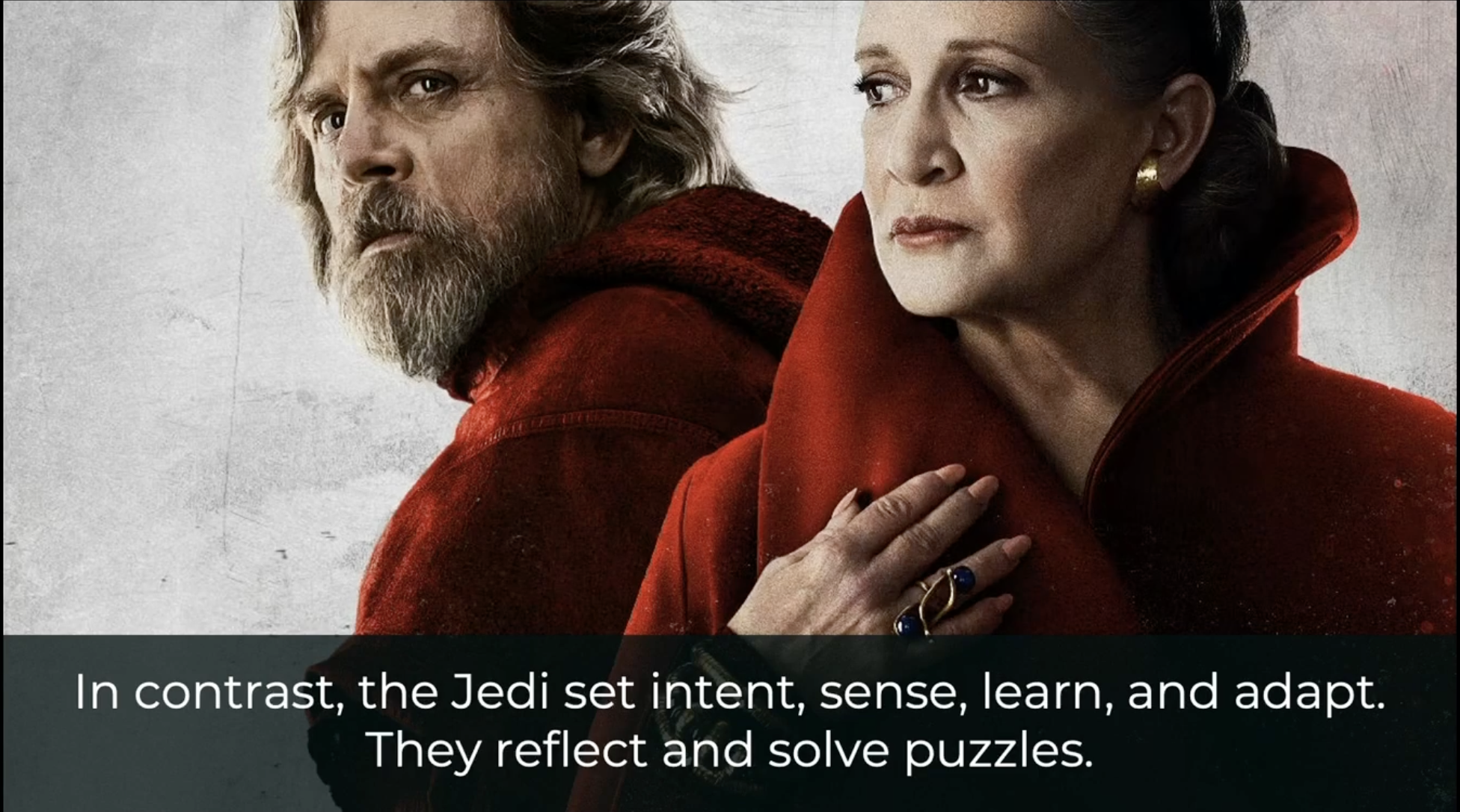
As inspiring as the Jedi may be, their advice is a little vague. What exactly does it mean to “use the force”?
Going beyond “use the force”: The OHLA framework
Radhika came up with the OHLA framework, which is a way of looking at problems with a mindset of experimentation, learning, and adaptation.
Here’s a quick overview. Each letter in OHLA represents an action to take:
O: Observe
H: Hypothesize
L: Learn
A: Adapt
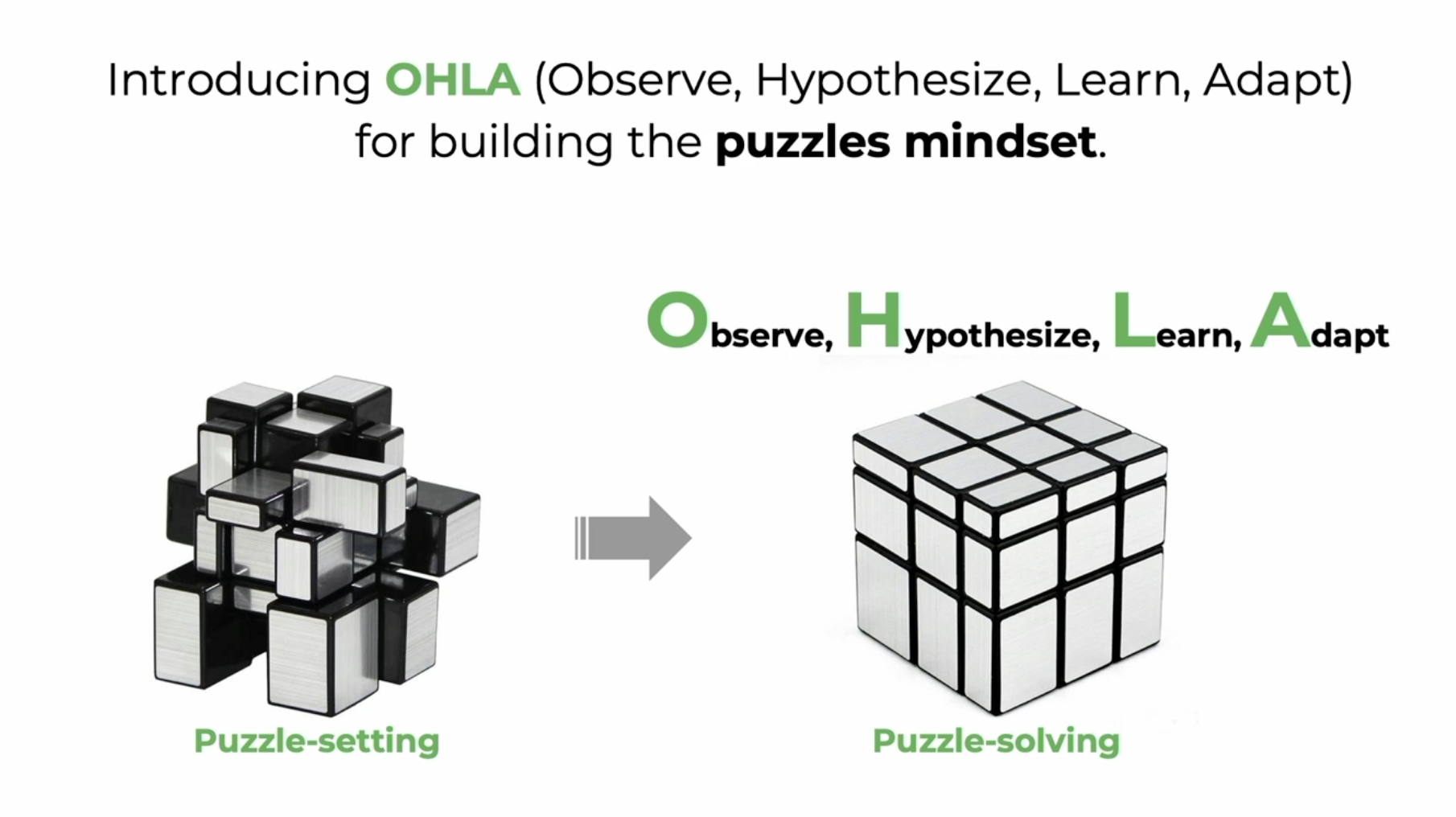
You might notice that this is quite a departure from the typical “build, measure, learn,” we often come across in the product world. Radhika called out why this distinction matters: “Before you start a puzzle or Rubik’s cube, you don’t just start moving pieces together randomly. You look at it—you observe.”
And while puzzle-setting and puzzle-solving aren’t typical vocabulary in a corporate setting, Radhika argues they should be. Thinking about problems as puzzles to be solved activates the creative part of our brain, generates more intrinsic motivation, and makes work a whole lot more fun!
A real-life example: Marvel vs. A24
To help illustrate the difference between chasing metrics in the typical way vs. taking a puzzle-solving approach, Radhika shared the example of Marvel and A24 film studios.
Marvel had their Jedi phase where they innovated and produced 10 of the top 30 highest-grossing movies of all time.

But since then, they’ve been solidly in Stormtrooper phase. How can you tell? The fact that—according to one New York Times review—“You’ve seen this movie 32 times before.”

A24, on the other hand, had the Jedi discipline of setting intent, sensing, learning, and adapting. Radhika outlined that puzzle-setting is a three-step process, which involves identifying the opportunity, open questions, and objective.
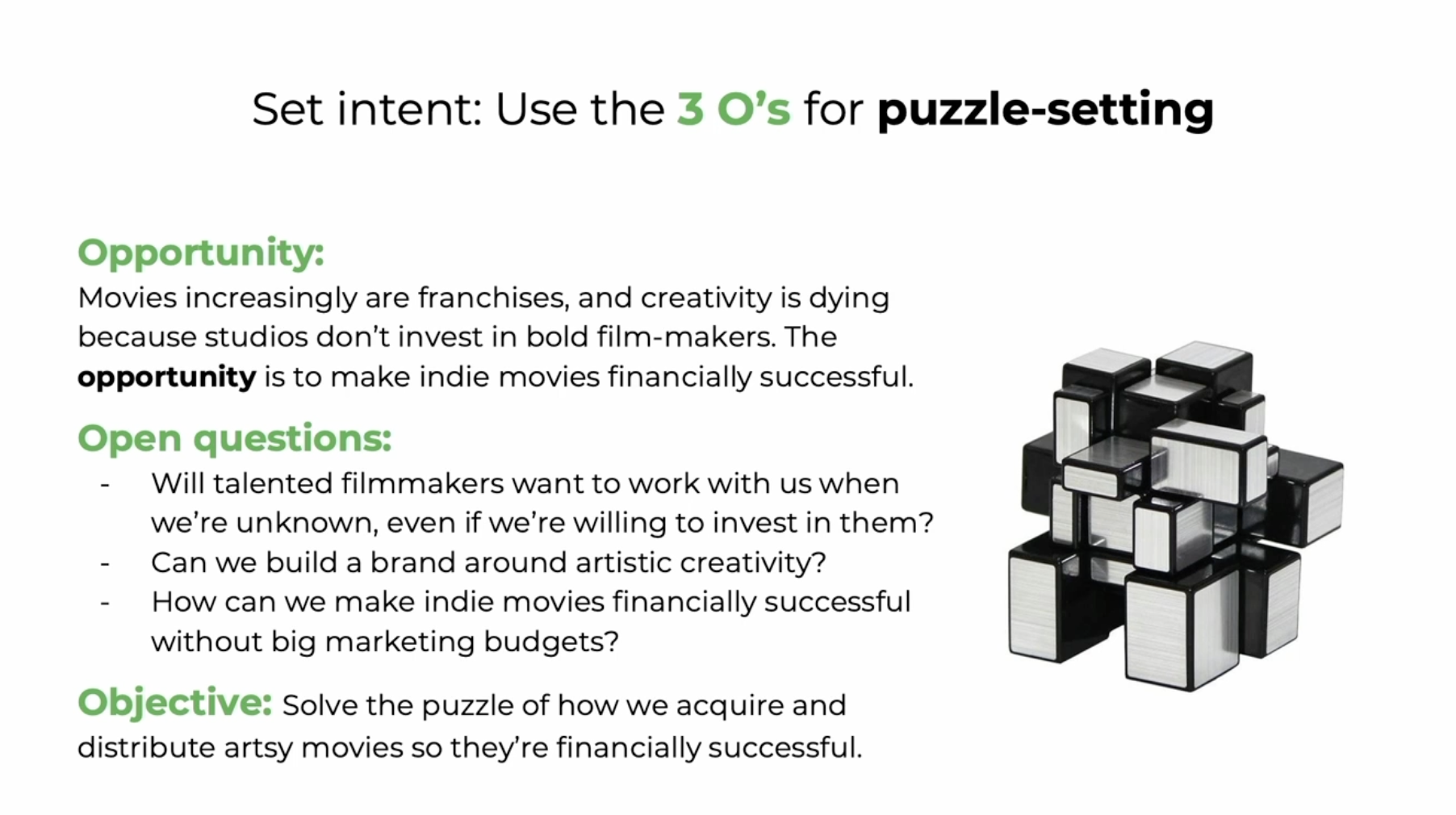
Once you set a puzzle, you can apply the OHLA framework to solving it. After you’ve observed and hypothesized, you can learn and adapt by asking yourself the following questions:
How well did it work?
What did we learn?
What will we try next?
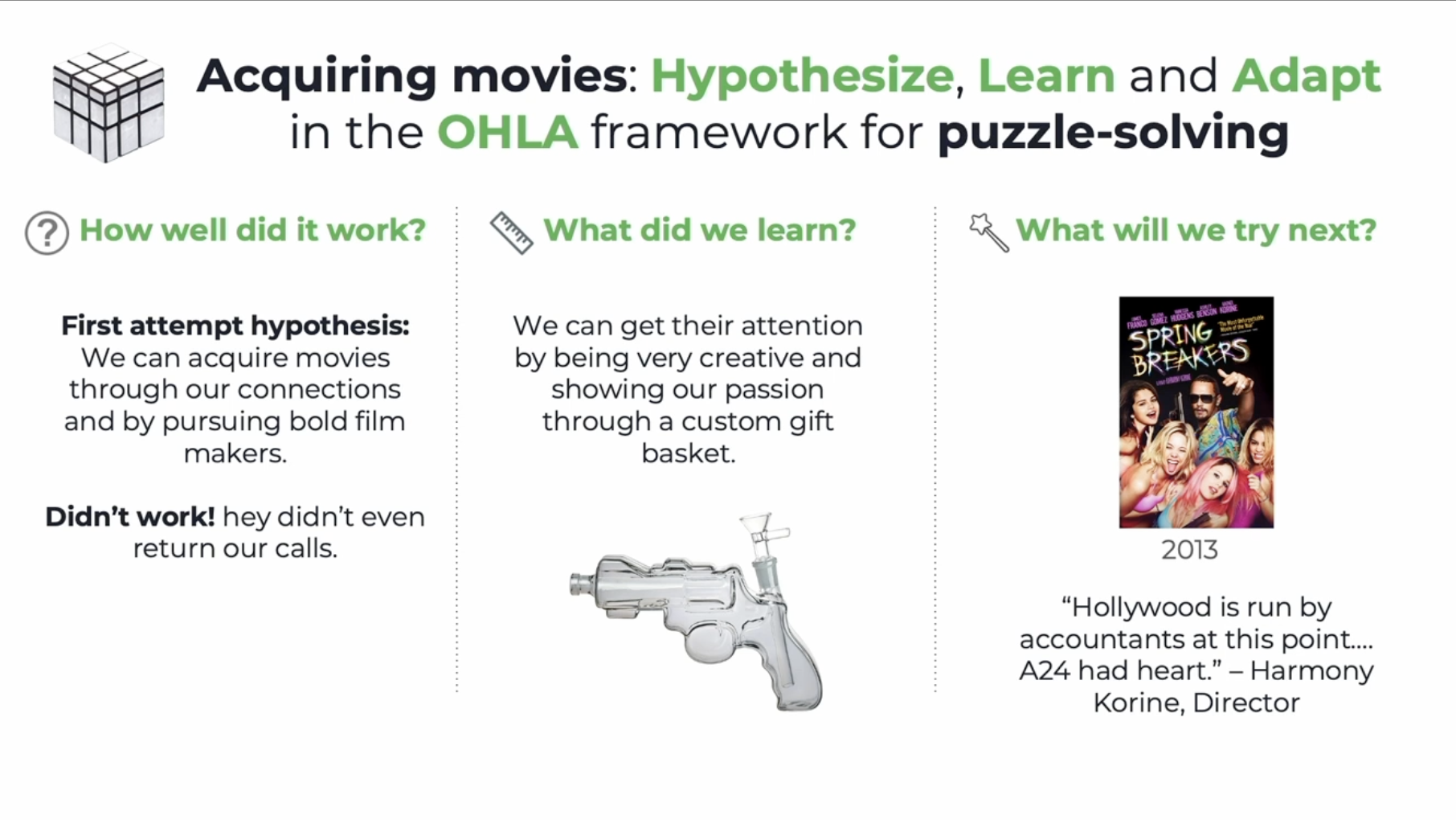
Radhika described how A24 used this approach to acquire movies. First, they tried simply reaching out to filmmakers whose work they admired, but this didn’t work. No one returned their calls. They learned that they needed to try more creative tactics to get filmmakers’ attention, so in their next attempt, they hand delivered a custom gift basket that included a gun-shaped bong. And it worked! This is how they acquired the movie Spring Breakers. The movie’s director, Harmony Korie, explained her reasoning for choosing to work with A24: “Hollywood is run by accountants at this point… A24 had heart.”
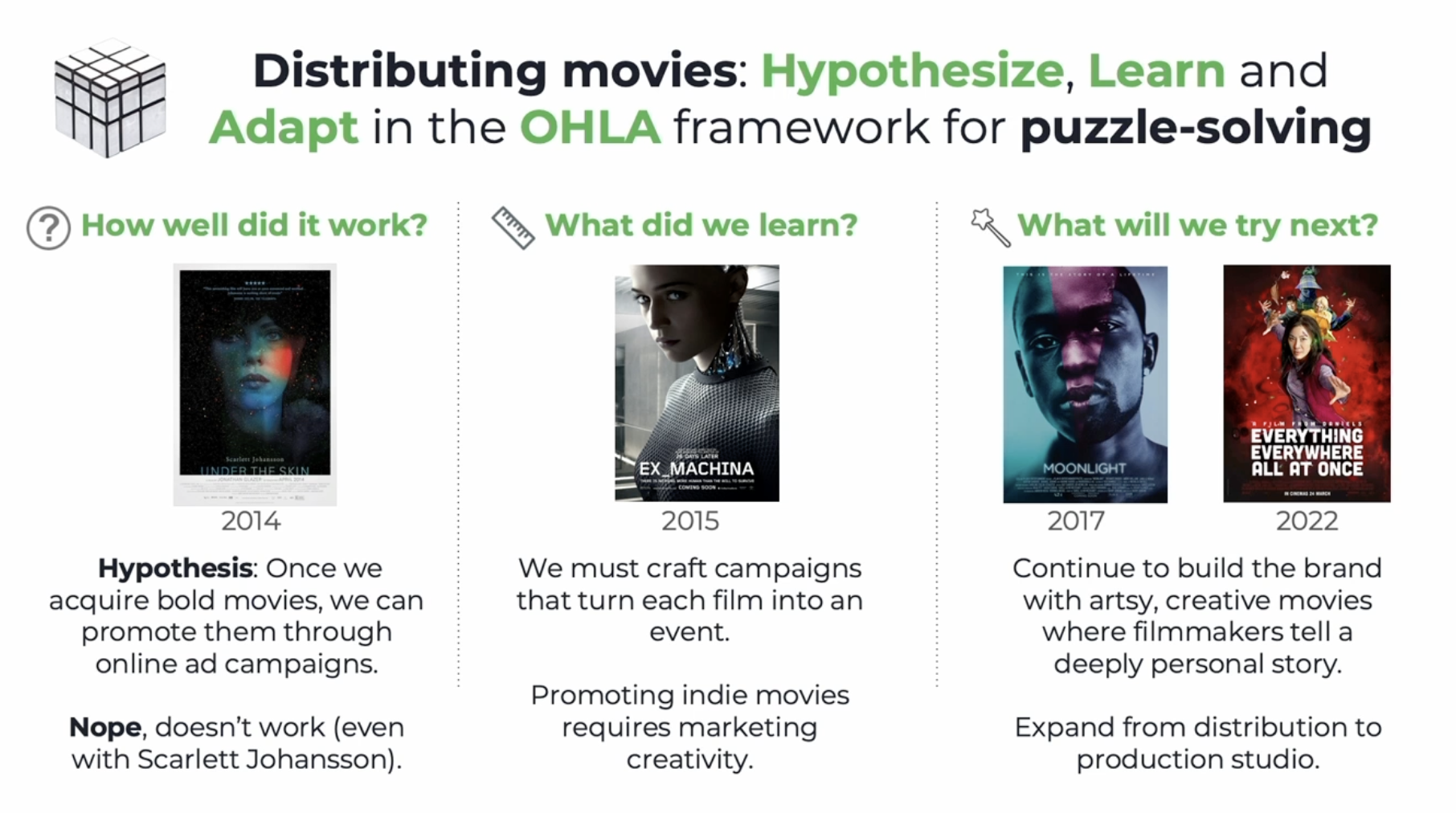
The A24 team went through a similar process with distribution. They quickly learned that it wasn’t enough to acquire bold movies with big stars—they also needed to turn each film launch into an event. For Ex Machina, they created a Tinderbot that would chat with Tinder users and eventually direct them to the movie’s website, which built interest in the movie and led to its success in the box office.
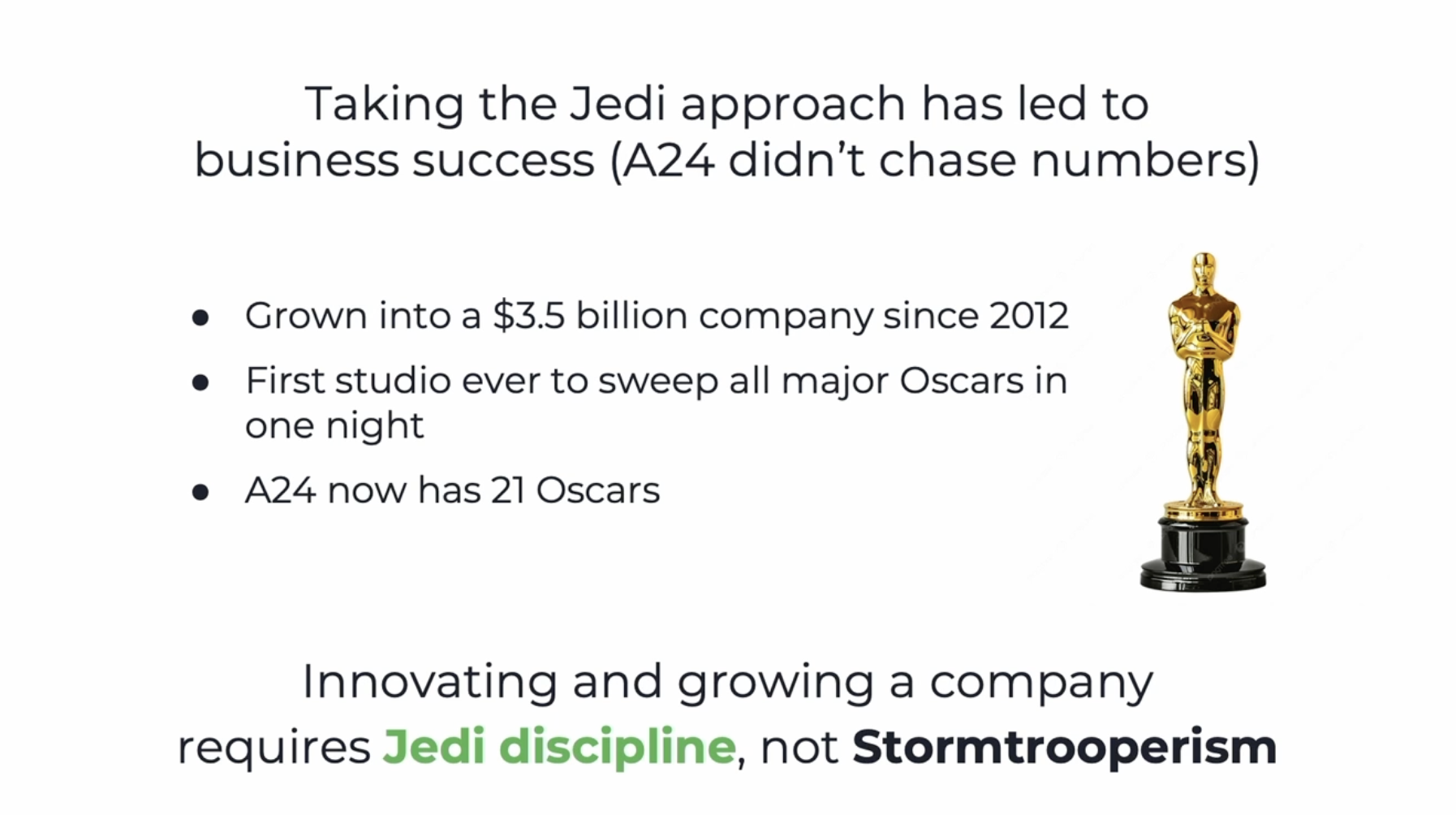
And while A24 didn’t chase numbers in the traditional sense, they’ve seen success in many typical metrics, including the company’s valuation and the number of Oscars they’ve won.
Surprise! CEOs actually love the puzzle-solving approach
Next, Radhika shared an example from a company she’s worked with. Data analytics platform Signal matches shipping vessels and cargo. They’d adopted an OKR-driven approach, but found that sales and usage had stagnated.
Under Radhika’s guidance, they shifted to the puzzle-setting and puzzle-solving mindset. They identified the following:
Opportunity: Sales have stalled because users are mostly tech-savvy brokers. Growth lies in expanding beyond this group.
Open questions: Why aren’t tech averse users in other roles using it? How are their mental models different? What do they need? Are we meeting their needs?
Objective: Grow the business by expanding to the tech averse users in other roles.
“Once we had set the puzzle, we could go about solving the puzzle,” said Radhika. The slide below highlights a few of their findings. Basically, they determined that tech-averse users needed more control over the process; not less.
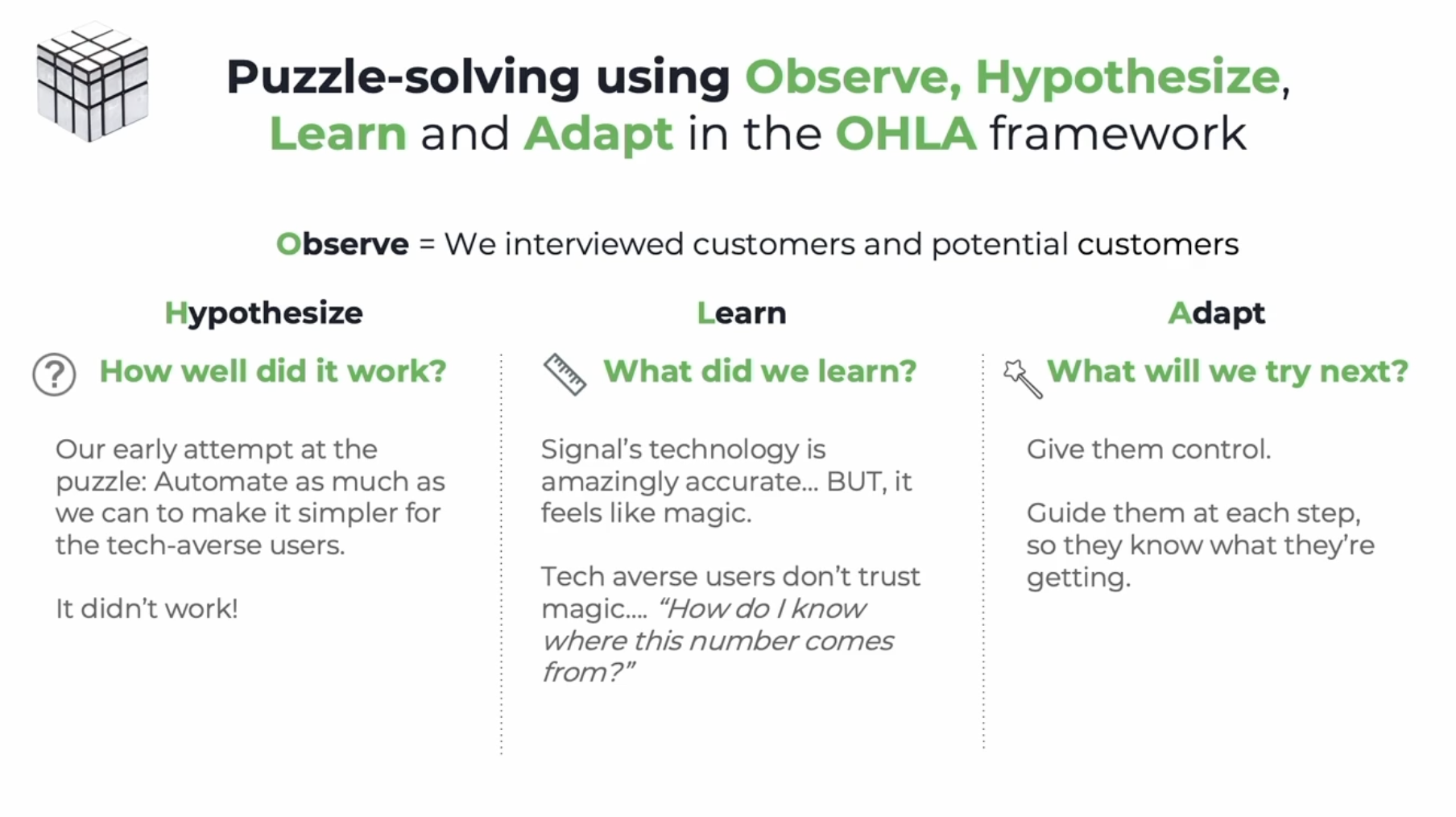
Once they took this approach, something amazing happened: Signal delivered better business results than they did when they were chasing numbers. Sales doubled in 2024 and 2025 and customer churn reduced from 26% to 4%.
Reflecting on the company’s work with Radhika and the OHLA framework, Signal CEO Ioannis Martinos said, “OHLA gives you ears on the ground—they make measurement actionable. In contrast, OKRs was the view from the rear view mirror—measurement was less actionable.”
The choice is yours…
Radhika invited us to choose which mindset and working style we’d like to adopt. We can either be Stormtroopers or Jedi.
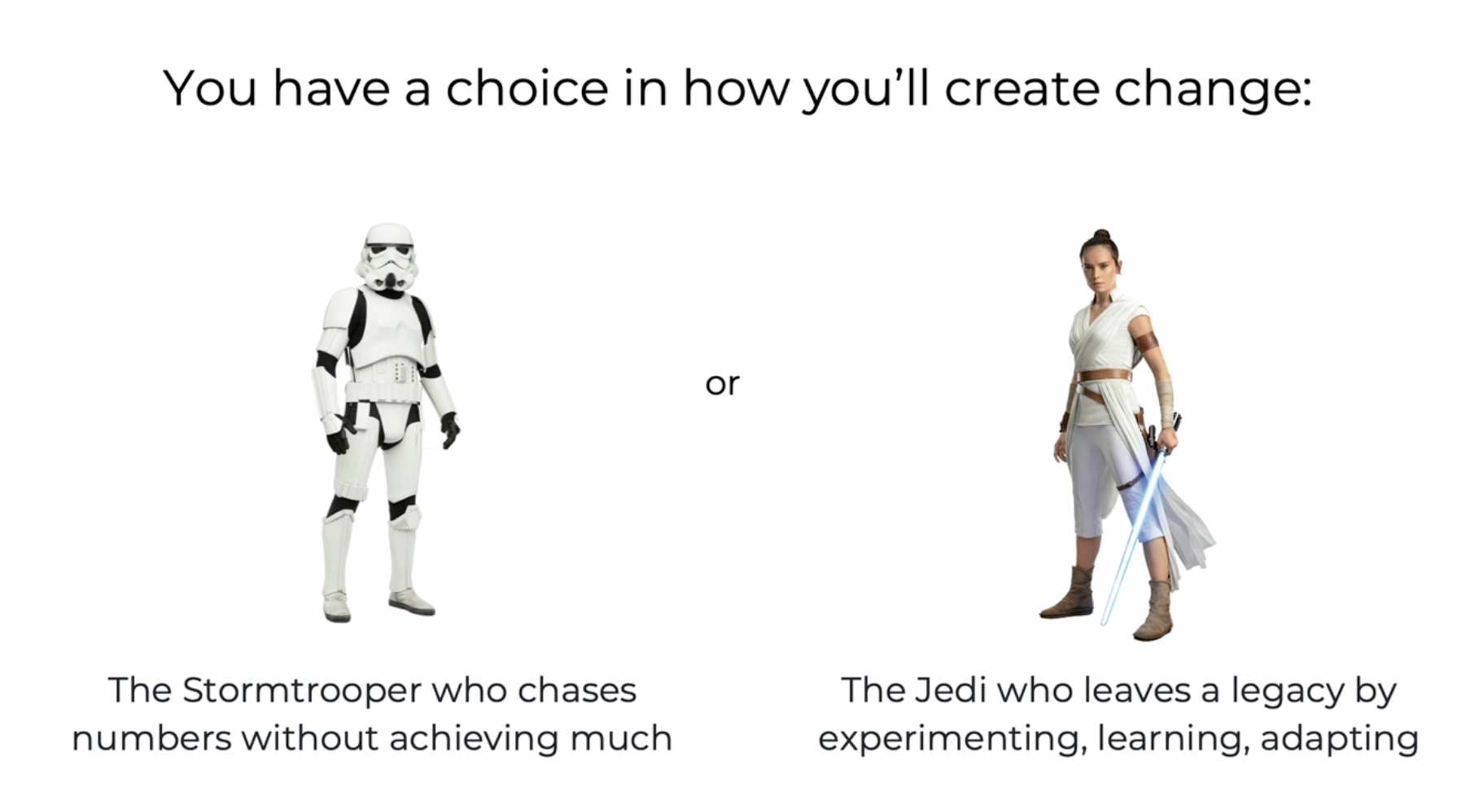
“Your choice matters because you vote with your labor for the world you want to create,” said Radhika.
Before closing, she described some of the risks of operating in a Stormtrooper culture. Think about it: The decisions you make within your product can lead to serious consequences for your users and society at large. Focusing on the wrong metrics or chasing them without time for reflection has led to unintended consequences in everything from AI products to dating to organ transplants.
Remember: Using OHLA to shift your mindset occurs in two steps.
Step 1: Puzzle-setting: Define the opportunity, open questions, and objective
Step 2: Start by observing, then hypothesize, learn, and adapt by asking: How well is it working? What have we learned? What will we do next?
You can download the OHLA toolkit to get started, and once you’ve given it a try, make sure to let Radhika know how it goes!